If you live in California, your electricity bill likely comes from one of the three major Investor-Owned Utilities (IOUs):
- Pacific Gas and Electric Company (PG&E)
- Southern California Edison (SCE)
- San Diego Gas & Electric (SDG&E)
But which one is actually the most expensive?
Let’s break it down clearly.
Or, 👉 click here to check your actual electricity rates for your home!
1️⃣ Average Residential kWh Rate Comparison (Early 2026)
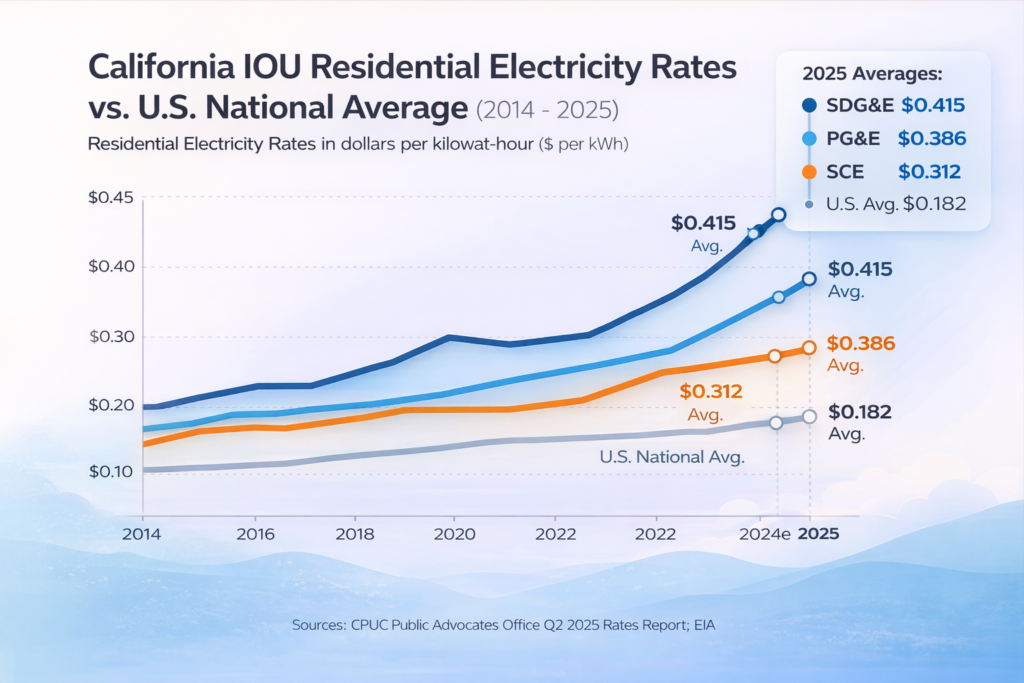
Electricity prices for major IOUs in California steadily increased from 2014, and by 2025, they were more than twice the national average.
Below are publicly posted average residential electricity rates (approximate values as of early 2026 rate updates):
| Utility | Average ¢/kWh | Relative Cost Level |
|---|---|---|
| SDG&E | ~45.7¢ | Highest |
| PG&E | ~41.5¢ | High |
| SCE | ~34.5¢ | Lowest of the three |
Ranking (Highest → Lowest)
- SDG&E
- PG&E
- SCE
Key Insight
The difference between SDG&E and SCE is roughly 11¢ per kWh.
If you use:
- 500 kWh/month → that’s about $55 difference
- 1,000 kWh/month → that’s about $110 difference
Over a year, that becomes significant.
2️⃣ Peak Hours Comparison (When Electricity Is Most Expensive)
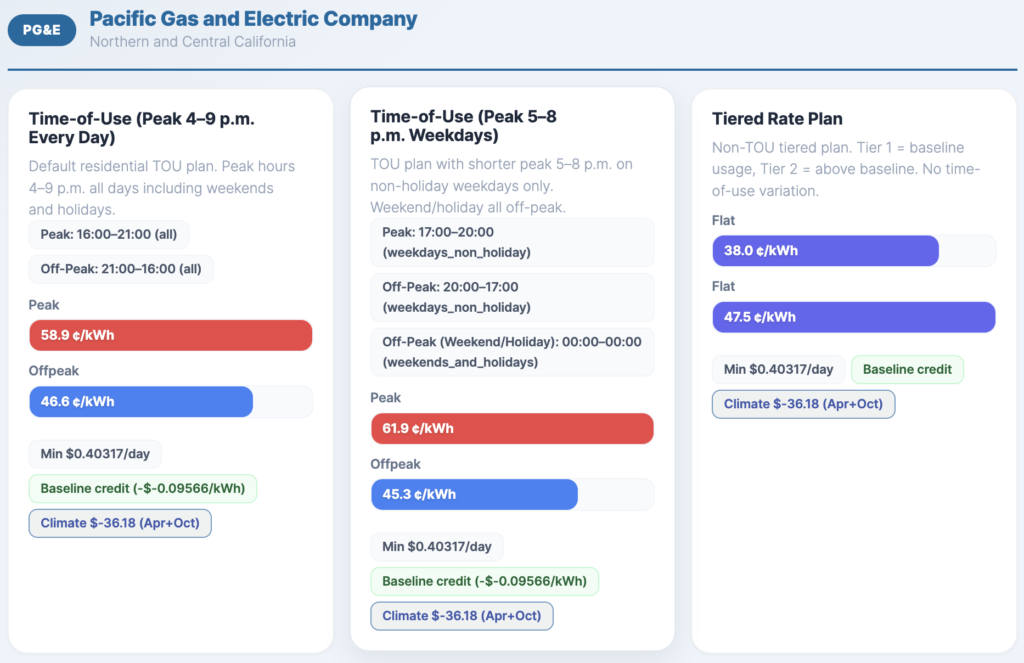
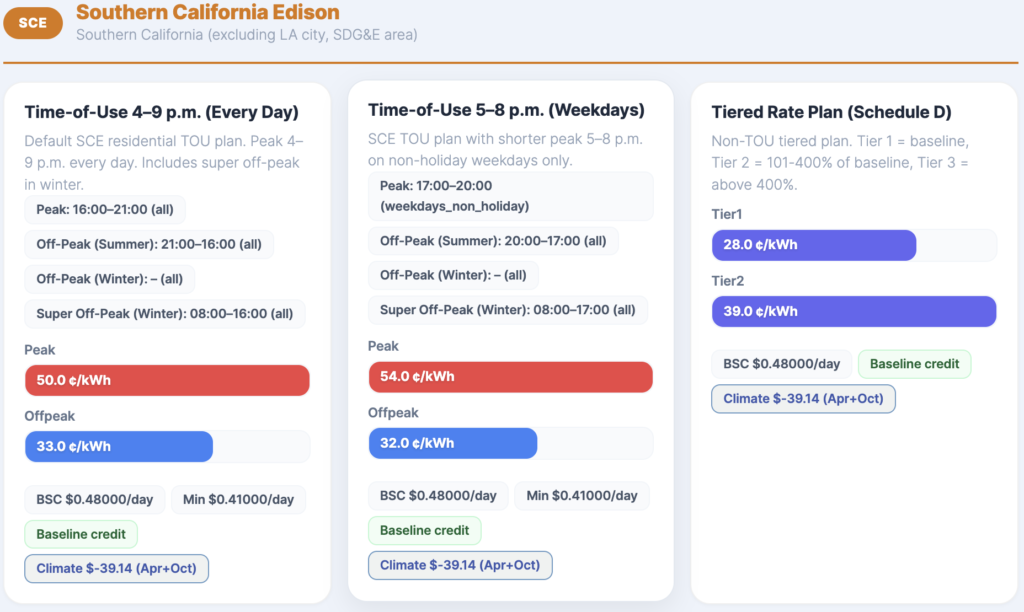
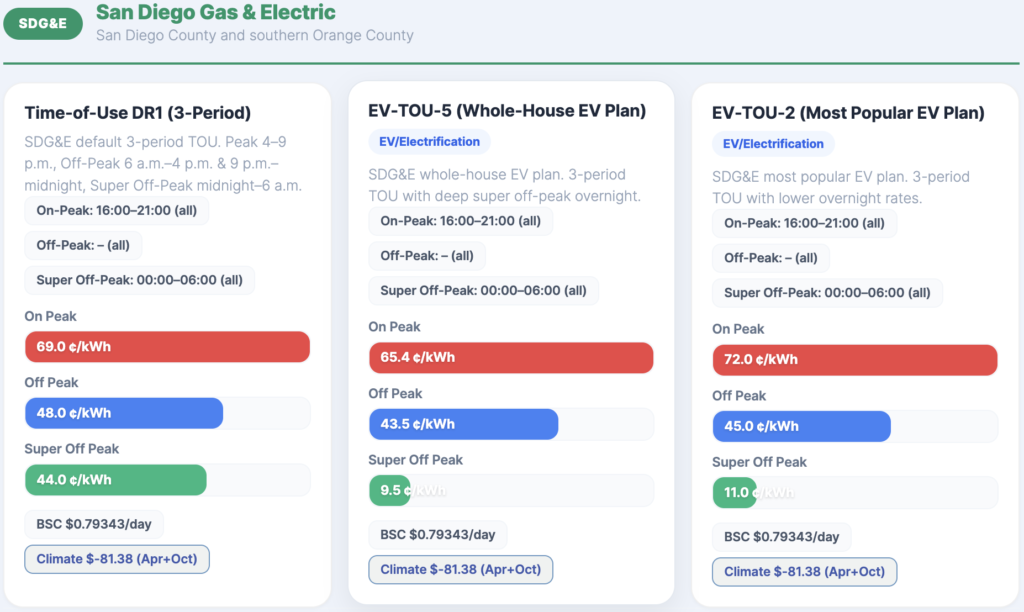
All three utilities heavily rely on Time-of-Use (TOU) pricing.
Common Peak Window
Most standard residential TOU plans use:
4:00 PM – 9:00 PM as peak hours
If those happen during 4–9 PM, your bill increases dramatically.
Find out more details about California ToU rates here.
- PG&E
- SCE
- SDG&E
3️⃣ Do They Offer EV TOU Plans?
Yes — all three IOUs offer EV-friendly rate plans.
– PG&E
Offers EV and electrification-focused TOU plans with discounted off-peak rates.
– SCE
Offers TOU-D-PRIME, designed for EV owners and electric homes.
– SDG&E
Offers EV-specific TOU plans (such as EV-TOU options) with super off-peak pricing.
What Matters More Than the Name
For EV owners, you should compare:
- Off-peak rate
- Super off-peak rate (if available)
- Daily fixed charge (if applicable)
- Whether your lifestyle allows nighttime charging
If you charge at midnight, EV plans can reduce costs substantially.
Curious about EV charging? Find out more details here.
4️⃣ What Changes If You Choose a CCA?
Many California residents are automatically enrolled in a Community Choice Aggregation (CCA) program.
What Changes
- The generation (electricity supply) portion comes from the CCA.
- The IOU still handles:
- Transmission
- Distribution
- Billing
- Outage response
What Stays the Same
Delivery charges remain from:
- PG&E, SCE, or SDG&E
Additional Consideration
You may see:
- PCIA (Power Charge Indifference Adjustment)
- Different renewable content options (e.g., 50%, 100%)
CCA does not automatically mean cheaper.
Total cost = Delivery + Generation + PCIA + Fees + Fixed Charges
Each region’s CCA pricing differs.
So… Who Is the Most Expensive?
If we look strictly at average residential rates in early 2026:
SDG&E is the most expensive.
Followed by:
- PG&E
- Then SCE
However, your actual cost depends more on your rate plan, when you use electricity, whether you’re on an EV plan, and whether you’re enrolled in a CCA
Two neighbors under the same utility can pay very different bills.
The Only Way to Know for Sure
Electricity pricing in California is highly localized and plan-specific.