California has one of the most complex residential electricity pricing systems in the United States. If you’re building a cost calculator, evaluating EV charging strategies, or simply trying to reduce your bill, it’s important to understand how the structure actually works.
This guide explains:
- Who sets your rate
- How generation and delivery charges work
- What Time-of-Use (TOU) means
- How Community Choice Aggregators (CCAs) fit in
- What additional charges appear on your bill
1️⃣ Who Supplies Electricity in California?
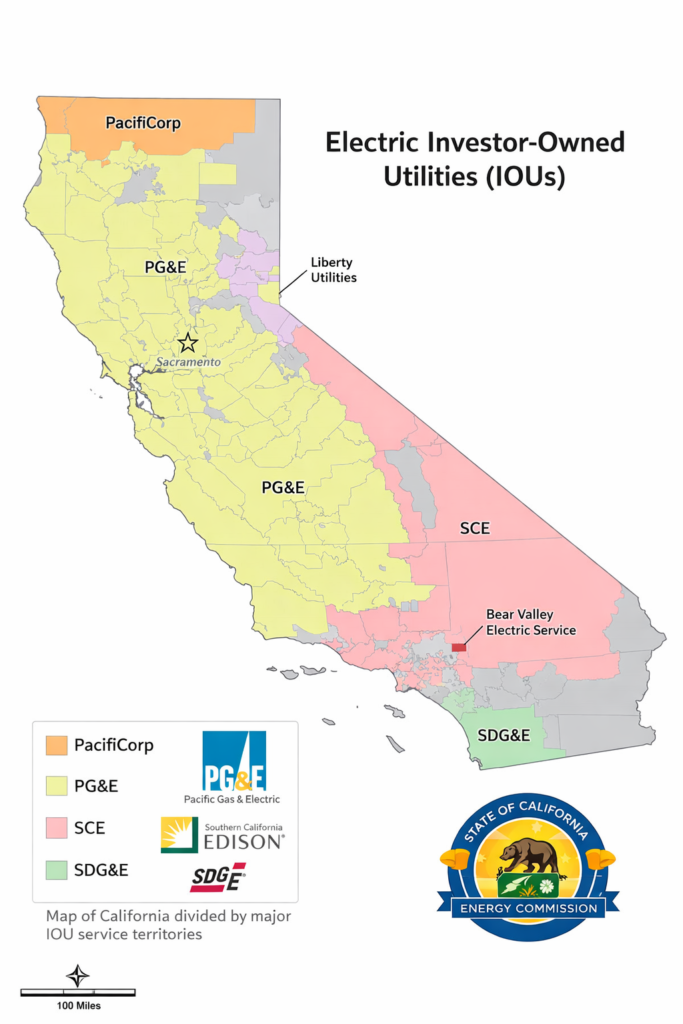
Most residential customers receive service from one of three major Investor-Owned Utilities (IOUs):
- Pacific Gas and Electric Company (PG&E)
- Southern California Edison (SCE)
- San Diego Gas & Electric (SDG&E)
These utilities own the transmission and distribution infrastructure (poles, wires, transformers). However, the entity that supplies your electricity (generation) may be different.
2️⃣ What About Publicly Owned Utilities (POUs)?
In addition to IOUs, some California residents receive electricity from Publicly Owned Utilities (POUs).
POUs are:
- Owned by cities, municipalities, or local districts
- Governed by local boards or city councils
- Not regulated by the California Public Utilities Commission (CPUC) in the same way as IOUs
Major Examples of POUs in California
- Los Angeles Department of Water and Power (LADWP)
- Sacramento Municipal Utility District (SMUD)
- Imperial Irrigation District (IID)
3️⃣ What Is a Community Choice Aggregator (CCA)?
A CCA is a local government program that purchases electricity on behalf of residents.
Well-known examples include:
- CleanPowerSF
- Silicon Valley Clean Energy
- East Bay Community Energy
Important:
- CCAs replace only the generation portion of your bill.
- Delivery remains with your IOU.
- You are automatically enrolled in many regions but can opt out.
Pricing Impact
CCAs often:
- Offer slightly lower generation rates, or
- Offer higher renewable energy percentages
However, they must pay a fee called the Power Charge Indifference Adjustment (PCIA) to the IOU, which offsets stranded generation costs. This reduces the price advantage in some cases.
4️⃣ Time-of-Use (TOU) Pricing
Most California residential customers are now on Time-of-Use (TOU) plans.
Under TOU:
| Time Period | Typical Cost |
|---|---|
| Off-Peak | Lowest |
| Mid-Peak | Moderate |
| Peak | Highest |
Peak hours are typically in the late afternoon and evening (e.g., 4 PM – 9 PM), when grid demand is highest.
This structure strongly incentivizes:
- EV charging overnight
- Running appliances outside peak windows
- Demand shifting
If you’re building an EV cost calculator, TOU structure is the most important pricing element.
5️⃣ Are There Tiered Rates?
Historically, California used tiered pricing based on usage volume (Tier 1, Tier 2, etc.).
Today:
- Most customers are on TOU.
- Some plans still include baseline allowances.
- High-usage customers may see higher marginal rates.
The trend is shifting away from strict tiered structures toward time-based pricing.
6️⃣ Fixed Charges and Minimum Bills
Your bill may also include:
- A monthly minimum charge
- Public Purpose Program charges
- Wildfire fund contributions
- Nuclear decommissioning fees
In 2025–2026, California regulators approved income-based fixed charges for some utilities. These are gradually being implemented and may change your monthly structure from purely volumetric pricing to partially fixed pricing.