If you searched “California high electric bill” or “why is PG&E so expensive,” you’re usually running into some combination of these four realities:
- Your local utility’s $/kWh is high (especially in IOU territories like PG&E, SCE, SDG&E).
- Time‑of‑Use (TOU) peak hours make late afternoon/evening power noticeably pricier.
- New bill structure changes can add a fixed monthly charge (“Flat Rate”) even if you conserve.
- If you’re in a Community Choice Aggregation (CCA) area, your bill’s generation section changes—and you may see an added adjustment like PCIA.
Before we go further, here’s the fastest path to the truth for your address:
👉 Check your exact rate here (enter your address)
If you want to compare power plan options, find out:
👉 Compare plans here (enter your address)
1️⃣ California average electricity price vs. your utility’s actual rate (IOU vs POU)
Statewide average (California)
The U.S. Energy Information Administration (EIA) reported 31.91¢/kWh for California residential electricity (November 2025 data, released Jan 26, 2026).
That number is a statewide average across many utilities—so your bill can be much higher (or lower) depending on where you live.
“Why is PG&E so expensive?” — a concrete 2026 benchmark
PG&E’s own rate advisory lists an average residential bundled (non‑CARE) rate of 41.46¢/kWh as of Jan 1, 2026.
IOU vs POU comparison
SMUD published a comparison using a 750 kWh/month residential bill as of Jan 1, 2026, showing big differences across California utilities.
Below is the same comparison with an “effective ¢/kWh” calculated from that 750 kWh usage (bill ÷ 750 kWh):
| Utility | Type | Avg monthly bill ($) | Effective rate (¢/kWh) |
|---|---|---|---|
| Turlock Irrigation District (POU) | POU | 137 | 18.3 |
| SMUD (POU) | POU | 149 | 19.9 |
| Roseville Electric (POU) | POU | 156 | 20.8 |
| Modesto Irrigation District (POU) | POU | 182 | 24.3 |
| LADWP (POU) | POU | 217 | 28.9 |
| Southern California Edison (IOU) | IOU | 283 | 37.7 |
| PG&E (IOU) | IOU | 311 | 41.5 |
| SDG&E (IOU) | IOU | 324 | 43.2 |
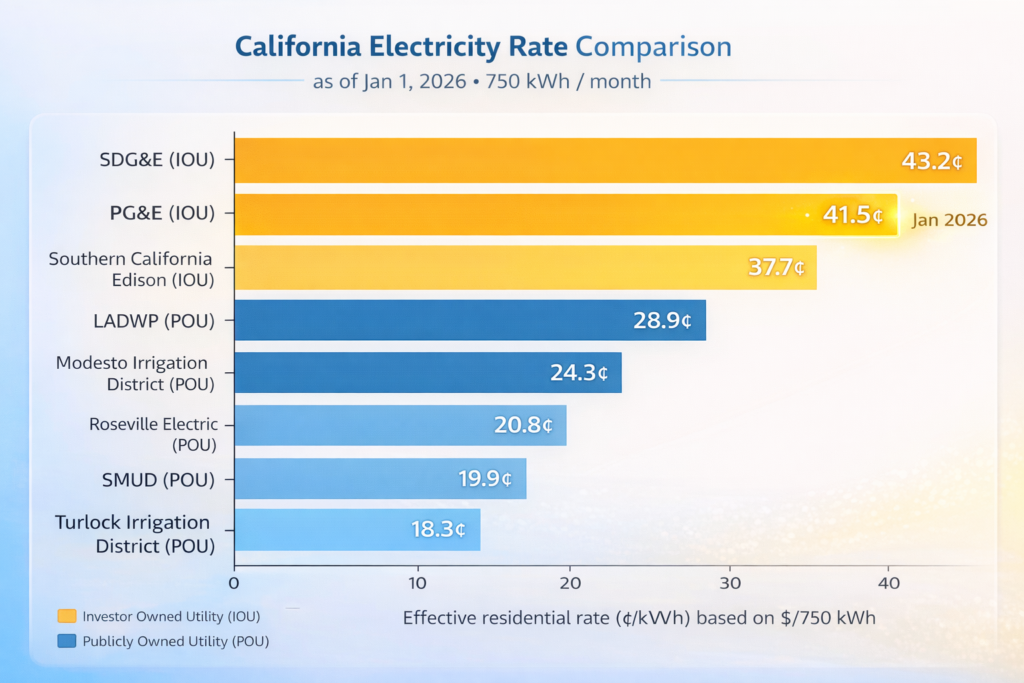
(Data source: SMUD “How our rates compare”, Jan 1 2026 snapshot.)
2️⃣ The “hidden” reason bills feel high: what you’re paying for (not just energy)
Your bill is not just “electricity.” It’s also the cost of delivering electricity safely and reliably—especially in high‑risk conditions.
California’s Legislative Analyst’s Office has flagged high and increasing electricity rates as a statewide problem that burdens residents and complicates electrification goals.
Key cost pressures commonly highlighted in official/public analyses include:
- Wildfire mitigation and wildfire liability pushing costs upward.
- Grid hardening investments (e.g., upgrades, protective measures, and in some cases undergrounding).
The CPUC notes (citing SCE) that underground conversion can be ~7× more expensive than some overhead mitigation options. - Policy and program costs that are recovered through rates (including low‑income discounts and other programs). PPIC notes multiple plausible contributors—wildfires, subsidies, and policy goals among them.
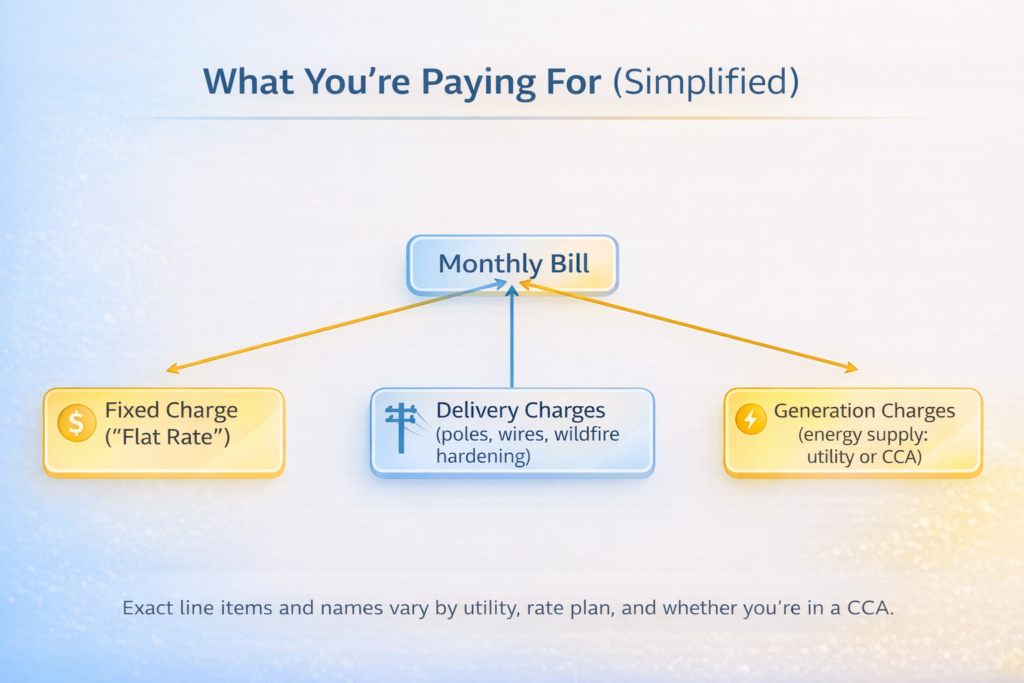
3) TOU (Time‑of‑Use) pricing: why peak hours hurt so much
What TOU is
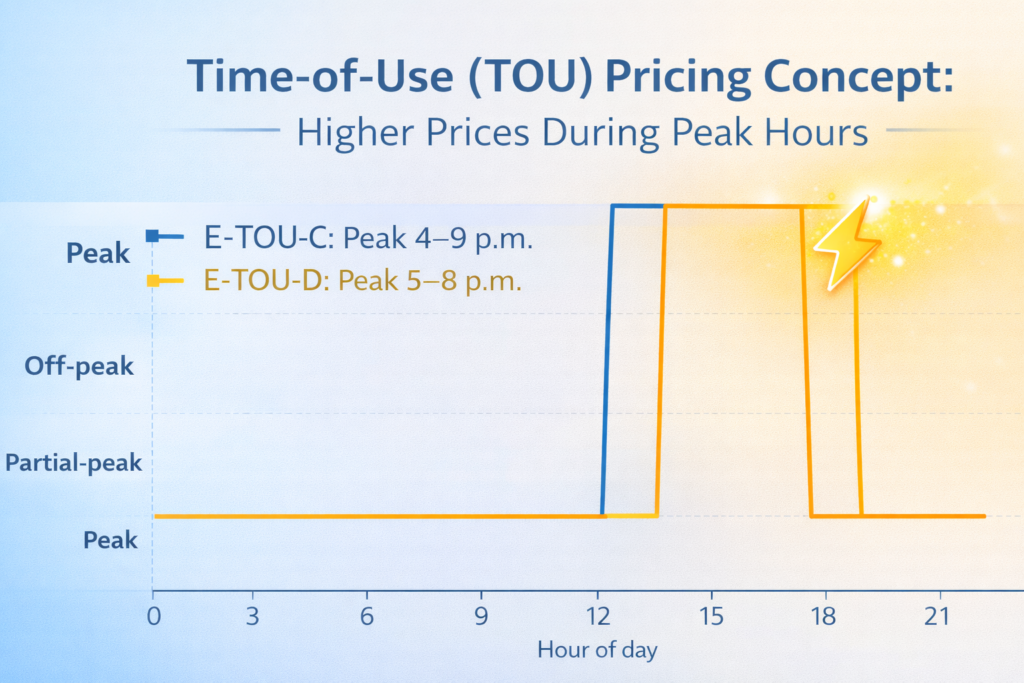
TOU means electricity prices change depending on the time of day. You pay more during “peak” hours when demand is high.
For PG&E’s TOU plans, PG&E summarizes typical peak windows like:
- E‑TOU‑C: 4–9 p.m. every day is higher‑priced peak time.
- E‑TOU‑D: 5–8 p.m. weekdays is higher‑priced peak time (with different weekend/holiday treatment).
Why this matters in real life
In many households, 4–9 p.m. is exactly when people are return from their work.
So even if your total kWh didn’t explode, your peak kWh might have—raising the bill.
Practical TOU moves that usually matter most
- Run dishwasher/laundry after peak (often later evening/night).
- Pre‑cool / pre‑heat before peak, then coast through peak.
- If you own an EV: schedule charging for off‑peak (see EV section).
4) If you have a CCA: what changes (and what doesn’t)
What stays the same
Even with a CCA, your IOU (like PG&E) typically still handles:
- delivery over the same wires
- meter reading
- billing
- maintenance and outage response
What changes
Your electric generation is purchased/provided by the CCA instead of the IOU. The CPUC notes your CCA generation charges are consolidated on the bill you receive from the IOU.
Why your bill can still look “weird”: PCIA
Many CCA customers see a line item called Power Charge Indifference Adjustment (PCIA).
- The CPUC describes PCIA’s purpose as keeping remaining customers “indifferent” to load departure, while ensuring departing load pays for certain legacy procurement costs.
- PG&E’s bill explainer similarly describes PCIA as a charge to ensure both bundled customers and those who buy generation elsewhere pay for above‑market costs of resources procured on their behalf.